VMC1370
VMC1370: where 1300 × 700 × 750 mm earns its footprint
The VMC1370 is the largest BT40 platform in the range: 1300 × 700 × 750 mm of travel on a 1400 × 700 mm table. It exists for the parts that a 1265 almost covers — the ones where 100 mm of X and 100 mm of Z decide whether the job runs in one set-up or two.
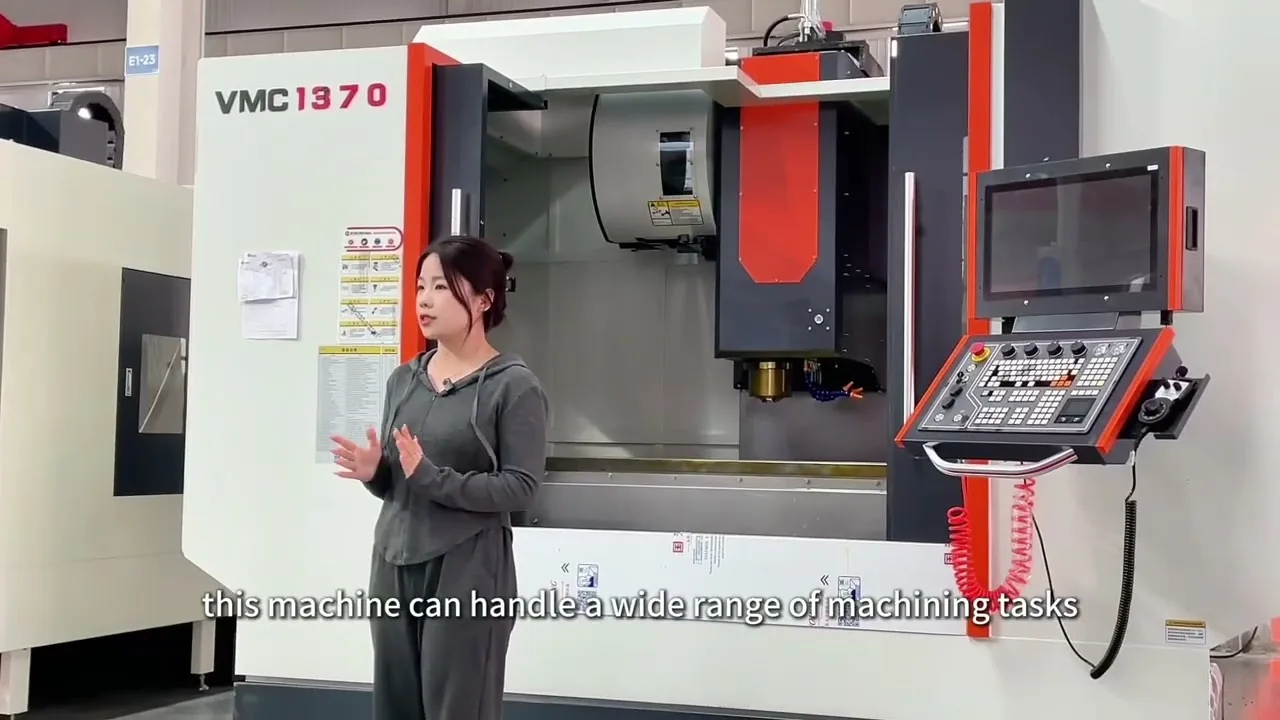
Video: Need to machine larger, heavier workpieces? Meet the HANDEMO VMC1370.#VMC1370 · Nicole Wang
750 mm of Z is the number to read first
Most comparisons stop at X travel. On this platform the figure that changes what you can quote is Z. At 750 mm, a 400 mm deep cavity sitting on a 150 mm fixture still leaves 200 mm of tool approach — the margin that lets a long-reach holder work without the machine running at the edge of its stroke.
That is why the 1370 shows up on mould and die work more than on flat plate: die blocks are tall, and the fixture under them is never thin. A 1265 with 650 mm of Z leaves 100 mm for a cavity-and-fixture stack of the same size, and 100 mm is not enough margin for a holder to clear the workpiece wall.
Spindle nose to table runs from a minimum that allows short tools to reach the table directly, up to a maximum that accommodates tall fixtures. That range, not the single travel figure, is what determines whether a tall part can be machined in one operation.
Table, load and T-slot pitch
The table is 1400 × 700 mm rated to 800 kg, with five 18 mm T-slots on 130 mm centres. The wider T-slot pitch suits larger fixture plates and mould clamping sets better than the 90 mm pitch on the smaller platforms — a big plate with widely spaced slots sits flatter and needs less shimming.
Eight hundred kilograms is the same rating as the 1160, which is worth understanding before ordering: the 1370 gives you envelope, not load capacity. If the parts are heavy rather than large, the answer is the 1580 at 1500 kg, not the 1370.
Both figures need checking together. A shop that buys the 1370 expecting it to carry heavier work because it is bigger will find the table rating unchanged, and a 1000 kg mould base needs the 1580 regardless of how well it fits the envelope.
Choosing between the 1370 and the 1370D
Both share the same 1300 × 700 × 750 mm envelope, the same 800 kg table and the same BT40-150 spindle at 8000 rpm. The D variant changes the structure, not the envelope — so the choice is not about size.
The practical rule: if the work is deep-cavity mould machining where tool reach and surface finish dominate, quote the D layout. If it is general plate and fixture work with moderate cavity depth, the standard 1370 does the job at a lower price and with the same travels.
Ask the question in terms of the cut rather than the catalogue. Deep cavities with long tools load the structure differently from face milling on a plate, and that difference is what the D variant addresses.
Footprint, weight and the checks before the order
Nine thousand kilograms on a 3550 × 2730 × 2620 mm footprint. The height is lower than the 1580 despite the larger envelope, which helps with workshop clearance, but the 3550 mm length needs checking against door width and crane access before anything else.
Rapid rates stay at 24 m/min in X and Y and 18 m/min in Z, so cycle-time expectations carry over from the smaller platforms unchanged. On a longer travel the absolute traverse time rises, but the rates themselves are familiar.
Because the machine is nearly four metres long, transport and rigging deserve attention early. A machine that fits the workshop but not the gateway is a problem discovered at the worst possible moment.
Where the 1370 sits in the range
Below it, the 1265 offers 1200 × 650 × 650 mm on a 1200 × 600 mm table with the same spindle. Above it, the 1580 switches to BT50-155 at 6000 rpm with 1500 kg of table load and 1500 × 800 × 700 mm of travel.
That places the 1370 as the last BT40 platform: the biggest envelope you can have before the spindle changes and the machine becomes a heavy-cutting tool rather than a general one.
For a shop whose work is mostly mould bases, die plates and large fixtures in aluminium and mild steel, that is the right place to stop. The step to BT50 is worth taking only when the material or the cutter size demands the extra torque, because it costs speed at the top end.
On a 1370 the specification that gets used is Z. Everything else is table stakes at this size.
Key points
- 1300 × 700 × 750 mm travel on a 1400 × 700 mm table, 800 kg load
- 750 mm of Z is why this platform wins mould and die work
- 1370D shares the envelope but changes the structure for deep-cavity cutting
- 3550 × 2730 × 2620 mm footprint, 9000 kg — check door and crane access first