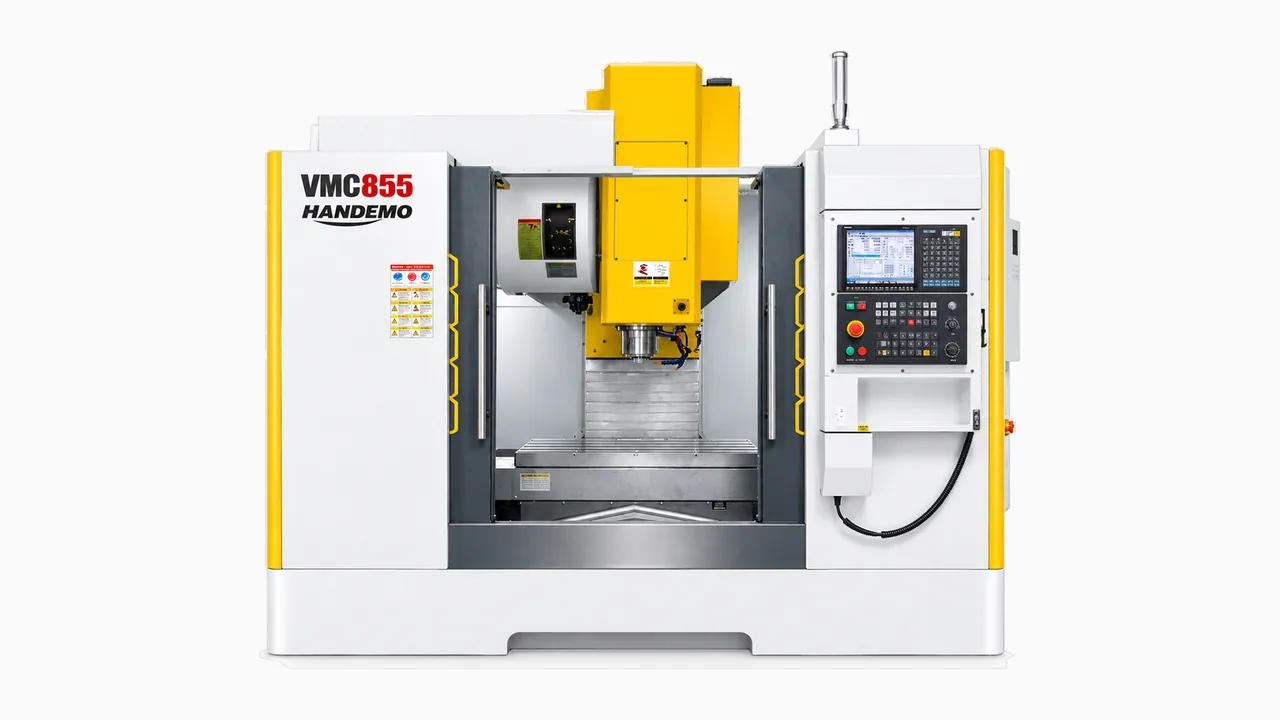
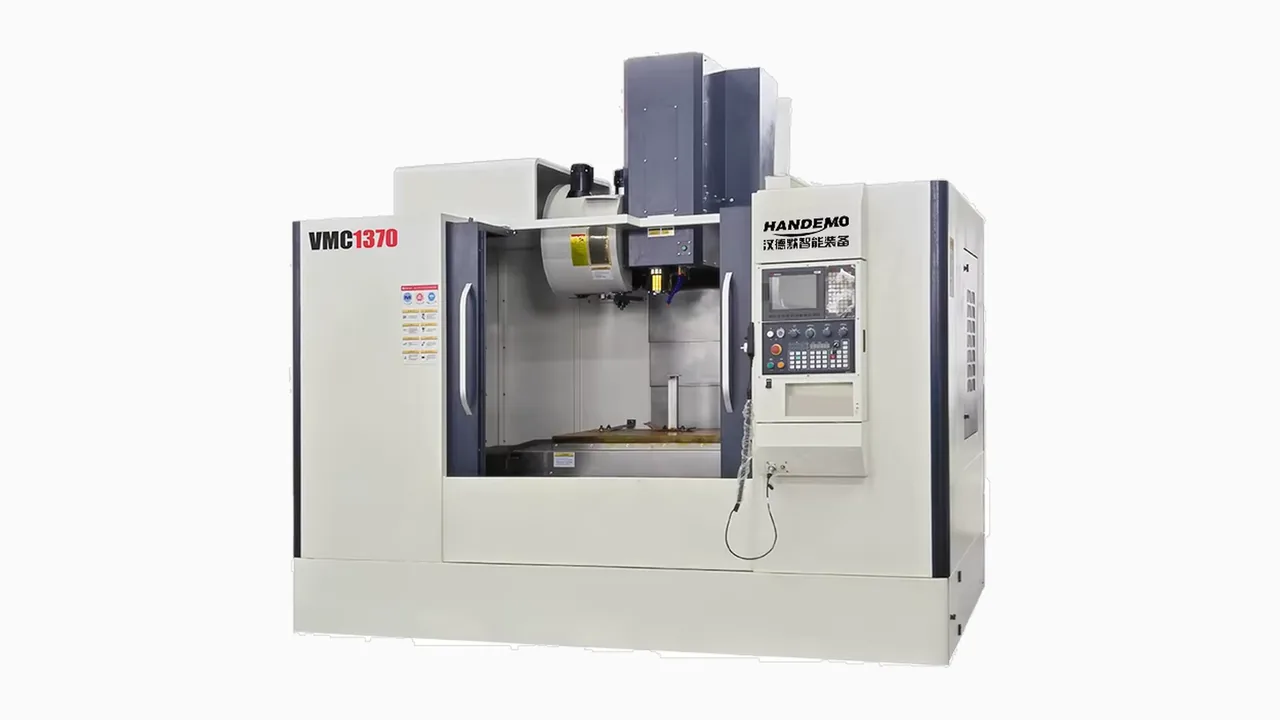
VMC1160
VMC1160: the 1100 mm platform for plate and fixture work
The VMC1160 sits where most of the range's volume lands: 1100 mm of X travel on a 1200 × 600 mm table rated to 800 kg, with the same BT40-150 spindle as the 855. It is the platform that carries fixture plates, mould bases and general subcontract work without stepping into BT50 territory.
Video: Let's take a look at the VMC1160vertical machining centre · Maoying Sheng
The 300 mm step that changes fixture planning
Compared with the 855, the 1160 adds 300 mm of X, 50 mm of Y, 50 mm of Z and 300 kg of table load. The table grows from 1000 × 550 to 1200 × 600. Those are not cosmetic increments — they are the difference between one clamp and two.
A 1000 mm plate that needed repositioning on the 855 sits inside the 1100 mm X travel with room for the tool at both ends. On fixture work that means a single set-up covers the whole plate, and the second operation disappears along with its datum transfer error.
The Y gain is smaller in absolute terms — 50 mm — but it is the 50 mm that decides whether a 600 mm wide plate goes on flat. Combined with the 600 mm Z travel, the working cube is 1100 × 600 × 600 against the 855's 800 × 550 × 550.
Same spindle, larger frame — and why that matters
The 1160 keeps the BT40-150 taper at 8000 rpm. Keeping the spindle identical across both platforms is deliberate: a shop that owns an 855 can move a job to a 1160 without re-buying holders, and operators see the same tool-change behaviour, the same pull studs and the same torque curve on both machines.
It also means the buying decision stays about envelope. If a job does not fit the 855, the question is not whether the 1160 cuts differently — it cuts the same way over a bigger volume. That simplifies spare-parts planning too, since spindle consumables are shared.
Rapid rates are 24 m/min in X and Y, 18 m/min in Z. On a 1100 mm X travel a full table traverse takes a few seconds, which is what non-cutting time reduces to on batch work. It is not the 32 m/min of the 855 high-speed option, and for positioning-dominated cycles that difference is measurable over a shift.
Table load and the fixture stack
Eight hundred kilograms of table load is the number to check against the real fixture stack, not the part weight alone. A 300 kg part on a 200 kg fixture plate with 150 kg of clamping hardware is 650 kg before the first chip lands.
The 1200 × 600 mm table takes five 18 mm T-slots on standard pitch, matching the clamping sets most subcontract shops already own. Larger fixture plates that needed two setups on the 855 usually fit in one here.
If the fixture stack approaches the rating, the answer is not to load it anyway. Table deflection under a heavy fixture shows up as taper in the part and as positioning drift at the far end of the travel — the kind of error that is blamed on the machine and caused by the setup.
Footprint, weight and installation
The machine measures 3100 × 2500 × 2800 mm and weighs 6500 kg. That is a standard ground-floor installation, and the 2800 mm height clears most container and workshop door limits without splitting the column.
Compared with the 855, the 1160 adds roughly 500 mm of length and 1200 kg. For a shop moving up from a smaller VMC, the practical checks are the door width, the crane hook capacity and the floor loading — in that order, and before the order rather than after.
Power, air and coolant requirements are issued as a foundation and utility schedule with the quotation, so the electrical work can be planned against real figures instead of assumptions.
When 1100 mm is not enough
The next step is the VMC1265, which extends X to 1200 mm and Z to 650 mm while keeping BT40-150. That extra Z matters for taller fixtures and deeper cavities more often than the extra 100 mm of X does.
If parts consistently exceed 1200 mm, or the material is hard enough that BT40 runs out of rigidity before the job runs out of envelope, the move is to the BT50 platforms — 1580 and above — rather than stretching the 1160 with long holders. A long holder on a BT40 is a workaround; a BT50 platform is the answer.
Between those two points the 1160 is the volume machine: big enough for plate and fixture work in one clamp, small enough to install in a normal workshop, and sharing its spindle with everything below it.
The 1160 is not a bigger 855. It is the point where a fixture plate stops needing a second clamp.
Key points
- 1100 × 600 × 600 mm travel, 1200 × 600 mm table, 800 kg load
- BT40-150 at 8000 rpm, 24 m/min rapid in X and Y, 18 m/min in Z
- 3100 × 2500 × 2800 mm footprint, 6500 kg — standard ground-floor install
- Move to VMC1265 for 650 mm Z, or to BT50 platforms above 1200 mm of work