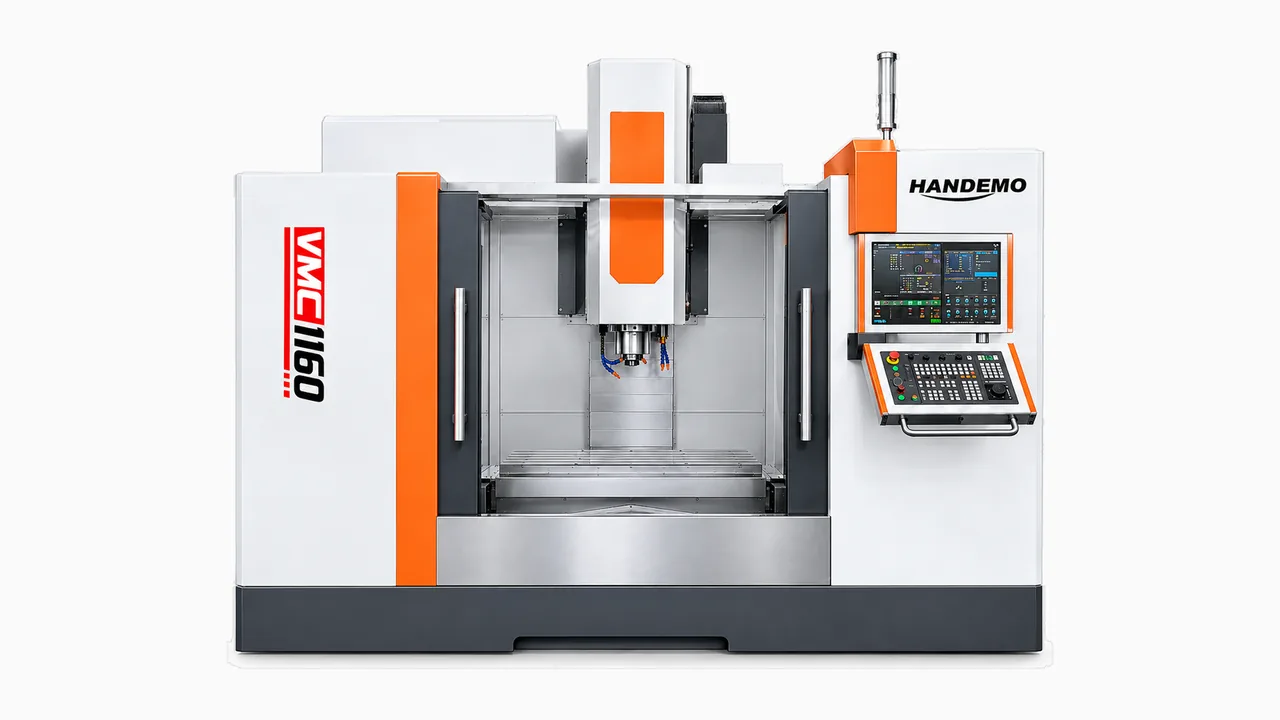
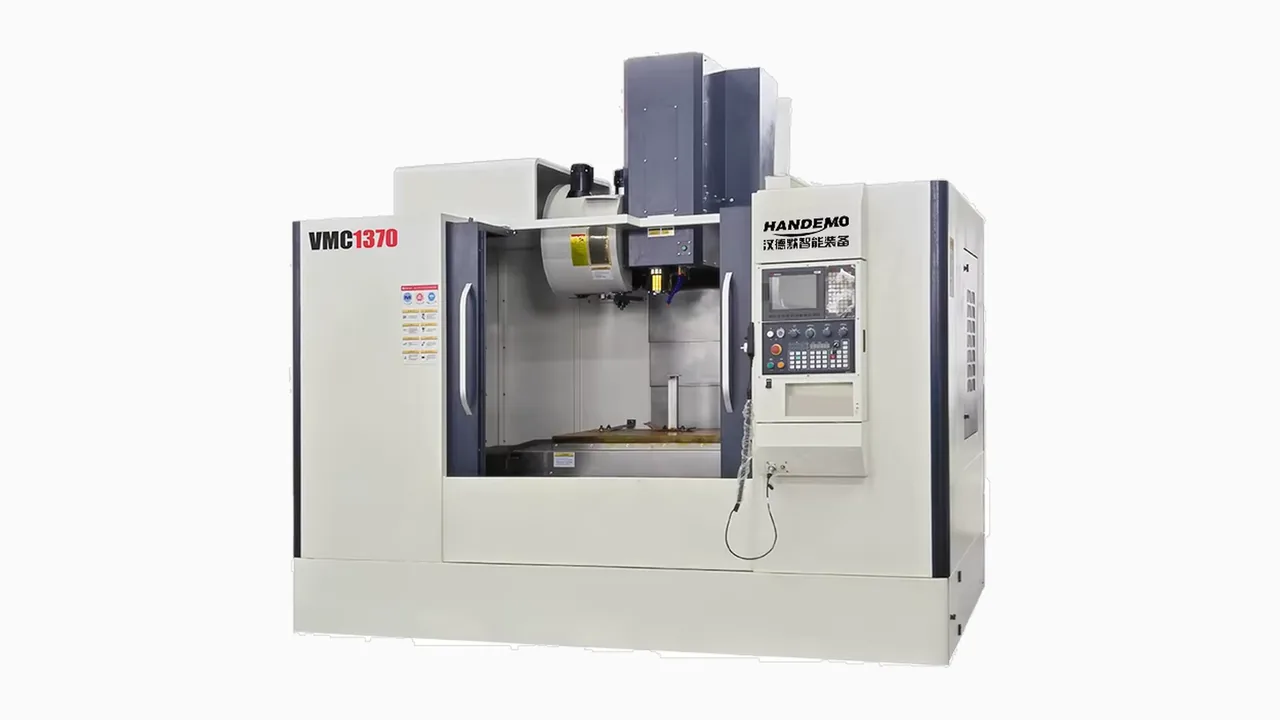
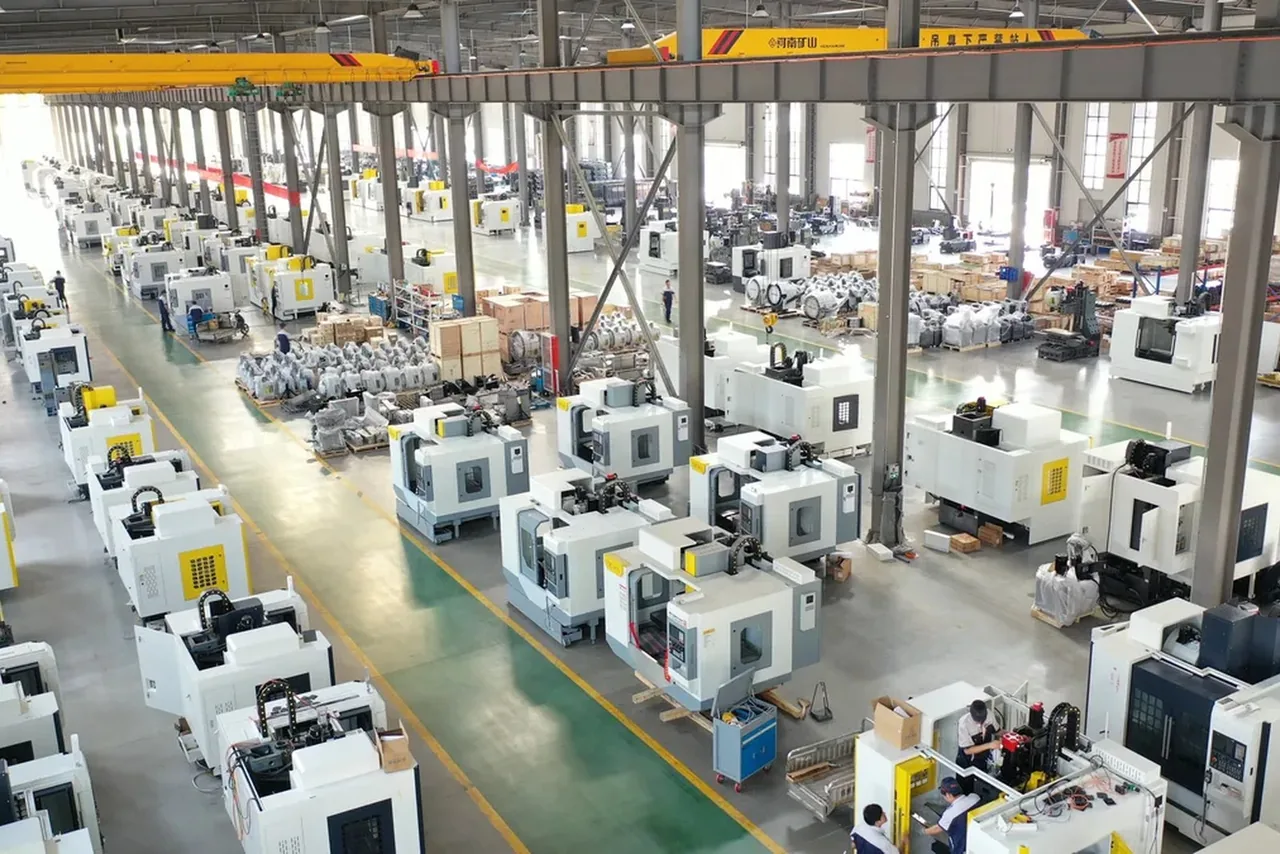
VMC855
VMC855: what an 800 × 550 × 550 mm envelope actually covers
The VMC855 is the smallest platform in the Handemo range and the one most first orders land on. Its numbers look modest on a specification table — 800 mm in X, 550 mm in Y, 550 mm in Z — but the useful question is not how big the envelope is. It is which of the three axes runs out first on the parts you actually run, and what that costs you in set-ups.
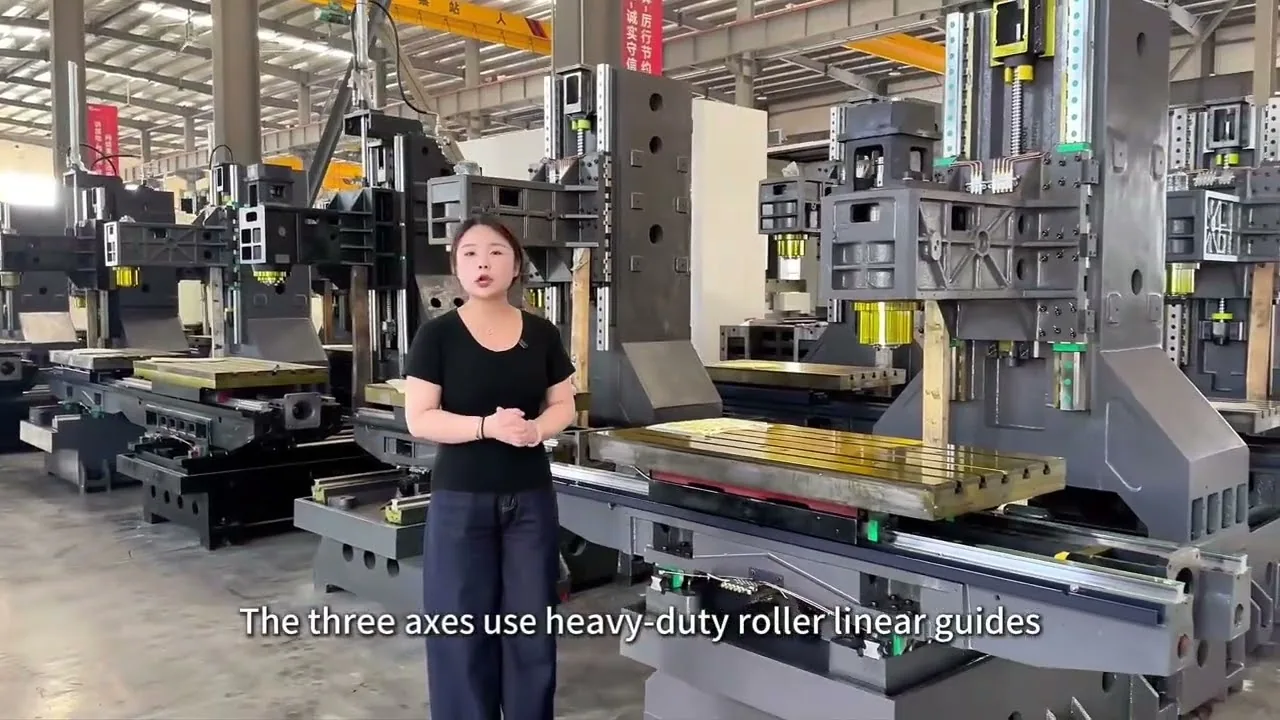
Video: VMC855 Vertical Machining Center – Rigid, Precise, Heavy-Cut Ready.#VMC855# · Nicole Wang
Y travel is the axis that limits most jobs
On a 1000 × 550 mm table, 800 mm of X travel sounds like the binding constraint until you measure the part. A 600 mm wide plate does not fit across the table at all, because Y travel is 550 mm — the table is wider than the axis can reach. In practice the Y axis decides whether a job stays on an 855 or moves up to an 866.
The 866 adds 50 mm to X and Y and 100 kg of table load, taking Y to 600 mm. That is exactly the difference between clamping a 600 mm plate flat and turning it 90 degrees, machining half, then re-fixturing and picking up the datum again. One is a single set-up; the other is two set-ups plus the risk of a mismatch across the joint.
This is why quoting off the X travel alone produces surprises. A part can be well inside 800 mm in length and still not fit, because the second dimension is what the table cannot give you.
Z travel and the fixture height nobody budgets for
Z travel is 550 mm, with 120 mm minimum and 670 mm maximum spindle nose to table. That 550 mm working range has to absorb three things at once: the fixture, the part, and the length of tool hanging out of the spindle.
A 150 mm fixture leaves 400 mm for part and tool approach. A 400 mm deep cavity in a hardened insert therefore uses the whole stroke before the tool reaches the bottom, and the last 50 mm of a deep pocket is where holders start rubbing and surface finish falls away.
The spindle centre sits 590 mm from the Z rail. That figure matters more than buyers expect: the further a tool hangs out of the spindle, the more that rail distance feeds into deflection at the cutting edge. A long-reach holder on a 550 mm Z machine is a compromise, not a solution — and it is the reason deep cavity work moves to the 1370 with its 750 mm of Z rather than being forced onto the smaller platform.
Table load, T-slots and clamping
The table is rated to 500 kg. Three 18 mm T-slots on 90 mm centres take standard M16 clamps, so most existing fixture plates transfer without modification. That compatibility is worth more than it sounds: a shop moving from another 40-taper machine usually keeps its clamps, its fixture plates and its tooling library.
Five thousand three hundred kilograms of machine on a 2600 × 2380 × 2400 mm footprint is light enough for a ground-floor shop without a special foundation. For a first VMC that is a real consideration — it means the installation decision does not depend on a civil works budget.
Two hundred and forty centimetres of height also clears most workshop doors and container loading without splitting the column, which keeps shipping and installation simple.
Spindle, magazine and what carries over
The spindle is BT40-150 at 8000 rpm, with a 24-station disc magazine and a 2.5 second tool change. Twenty-four stations covers most mould, plate and fixture work without a second setup for tools, and the 150 mm nose extension gives clearance that a short-nose BT40 does not.
Accuracy is published as 0.008 mm positioning and 0.005 mm repeatability on all three axes, to JIS B6336-4:2000 and GB/T 18400.4-2010. Those are the acceptance criteria the geometry check is measured against, not independent marketing numbers.
Tooling carries upward through the range. A BT40-150 holder bought for an 855 works on a 1160, a 1265 and a 1370, so a shop that adds a second machine does not rebuild its tooling library.
Where the 855 stops being the right answer
Three signals say move up rather than work around it. The part is wider than 550 mm in Y. The part plus fixture exceeds 500 kg. Or the batch is large enough that re-clamping for a second operation costs more than the price difference to a 1160 over the life of the job.
There is a fourth signal that is easy to miss: rapid rates. The 855 runs 24/32 m/min in X and Y and 18/24 in Z. On short-travel work that is irrelevant, but on a job that traverses the full table hundreds of times a shift, the difference between 24 and 32 m/min shows up in the cycle time.
If none of those apply, the 855 holds its accuracy and its price advantage. It is the platform that makes a first VMC affordable without making it a compromise — provided the parts are sized against Y and Z, not against X alone.
The 855 is not limited by how much it can reach. It is limited by how wide the part is when it arrives on the table.
Key points
- 800 × 550 × 550 mm travel on a 1000 × 550 mm table rated to 500 kg
- Y travel of 550 mm is the binding constraint for plate work, not X
- BT40-150 at 8000 rpm, 24-station disc magazine, 2.5 s tool change
- Step up to VMC866 when the part is 600 mm wide or needs 100 kg more table load