BT40 spindle
BT40-150: what the taper and the 150 actually mean for your parts
BT40-150 appears on most specification sheets in the range and is rarely explained. The number is not a quality grade — it is a dimension, and it predicts what the spindle can and cannot do more precisely than any marketing description.
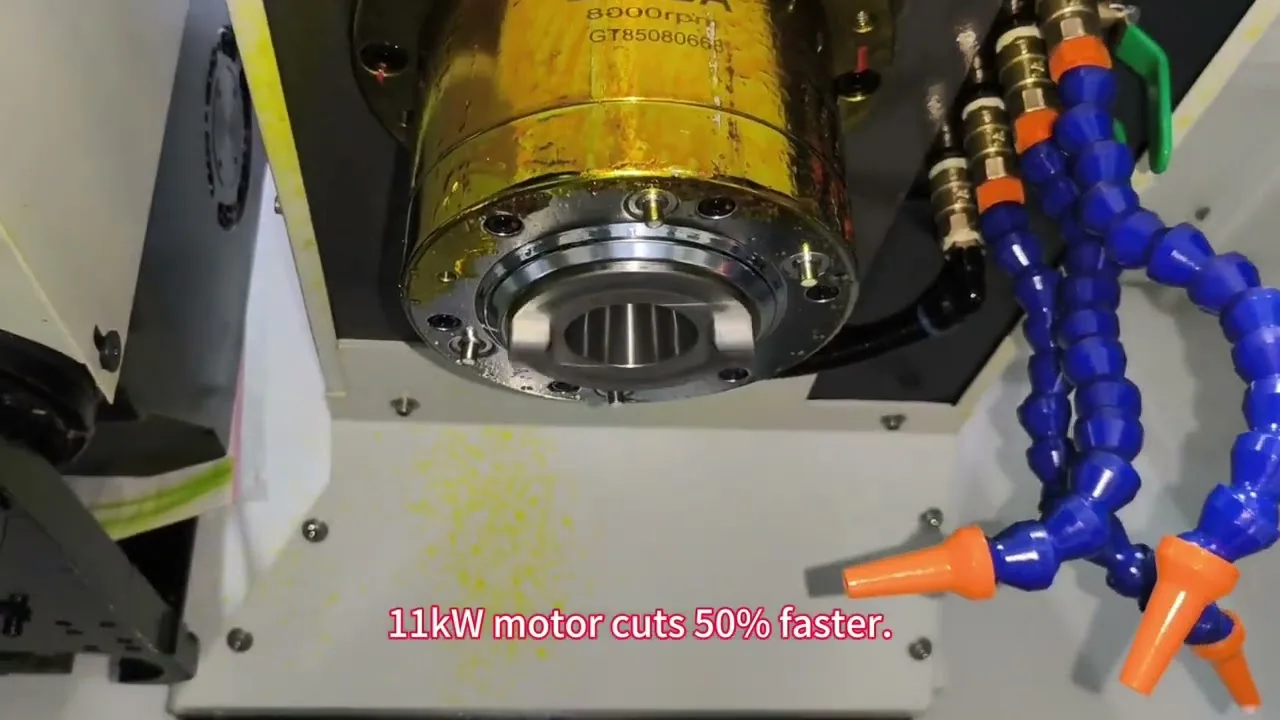
Video: BT40-150 spindle. #handemo #machine · Maoying Sheng
Reading the designation
BT40 is the taper: a 7:24 self-releasing taper with a 40 mm nominal gauge diameter. The 150 refers to the spindle nose extension — how far the taper sits from the housing face.
A longer nose gives more clearance between the spindle face and the workpiece, which is what lets a short, stiff holder reach into a cavity without the housing fouling the part. It does not make the spindle more rigid; if anything a longer nose trades a little stiffness for access.
That trade is the whole point of the designation. A machine with a short nose is stiffer but cannot reach; one with a long nose reaches further at the cost of some rigidity. BT40-150 is the compromise most general machining work sits on.
BT40 against BT50
BT50 uses a 50 mm gauge diameter and carries materially more torque. In this range it appears from the VMC1580 upward, where the spindle runs at 6000 rpm instead of 8000 and the machine is built for heavier cuts in harder material.
The trade is speed against torque. BT40 at 8000 rpm suits aluminium, mild steel and finishing work where the tool diameter stays moderate. BT50 at 6000 rpm suits heavy roughing and large-diameter tooling, at the cost of top-end speed.
Tooling cost follows the same split. BT50 holders are larger, heavier and more expensive, and a full magazine of them costs noticeably more than the BT40 equivalent. For a shop that runs mostly finishing passes, that money buys torque it never uses.
Where BT40 stops paying
Two conditions push a job off BT40. The first is tool diameter: large face mills and big indexable cutters need the BT50 gauge diameter to transmit the torque without chatter. The second is material removal rate on hard stock, where depth of cut is limited by spindle stiffness rather than by the axis drives.
If neither applies, BT40 is the right choice — cheaper to tool, faster to change and covering the majority of mould, plate and fixture work. Most shops that buy BT50 "for headroom" end up cutting the same light passes at a lower spindle speed.
A useful test is to name the largest cutter you intend to run and the deepest cut in the hardest material. If both answers sit comfortably inside BT40 territory, the extra torque is theoretical.
Speed, torque and the 8000 rpm ceiling
Eight thousand rpm is the standard ceiling on the BT40 platforms here. That suits small-diameter tooling in aluminium and finishing work in steel. It is not a high-speed spindle, and jobs that need 15,000 rpm for small cutters belong on a different machine class entirely.
Where the ceiling matters is cycle time on light cuts. A finishing pass with a 6 mm cutter runs faster at higher rpm, and if the job is finishing-dominated the spindle speed is the constraint rather than the feed drives.
For the majority of mould and plate work, 8000 rpm with a rigid BT40 taper is the better balance than a faster spindle with less torque at low speed.
What to check on the quotation
Confirm the taper specification (BT40 versus CAT40 versus ISO40 — holders are not interchangeable), the pull-stud type, and whether the spindle is belt-driven or direct-drive. Those three items change the torque curve far more than the taper number does.
Also confirm the tool-holder set that ships with the machine, if any, so the first tooling order is sized against what is already in the crate rather than duplicating it.
And ask for the spindle warm-up procedure in writing. A BT40 spindle run cold at 8000 rpm for the first time is a bearing-life decision made badly, and it is the cheapest thing on this list to get right.
BT40-150 is a dimension, not a rating. It tells you where the nose sits, not how hard you can push it.
Key points
- BT40 is a 7:24 taper with a 40 mm gauge diameter; 150 is the nose extension
- Longer nose buys clearance for cavity work, not additional rigidity
- BT50 from VMC1580 upward: more torque at 6000 rpm, less top-end speed
- Confirm taper standard, pull-stud type and drive type — not just "BT40"